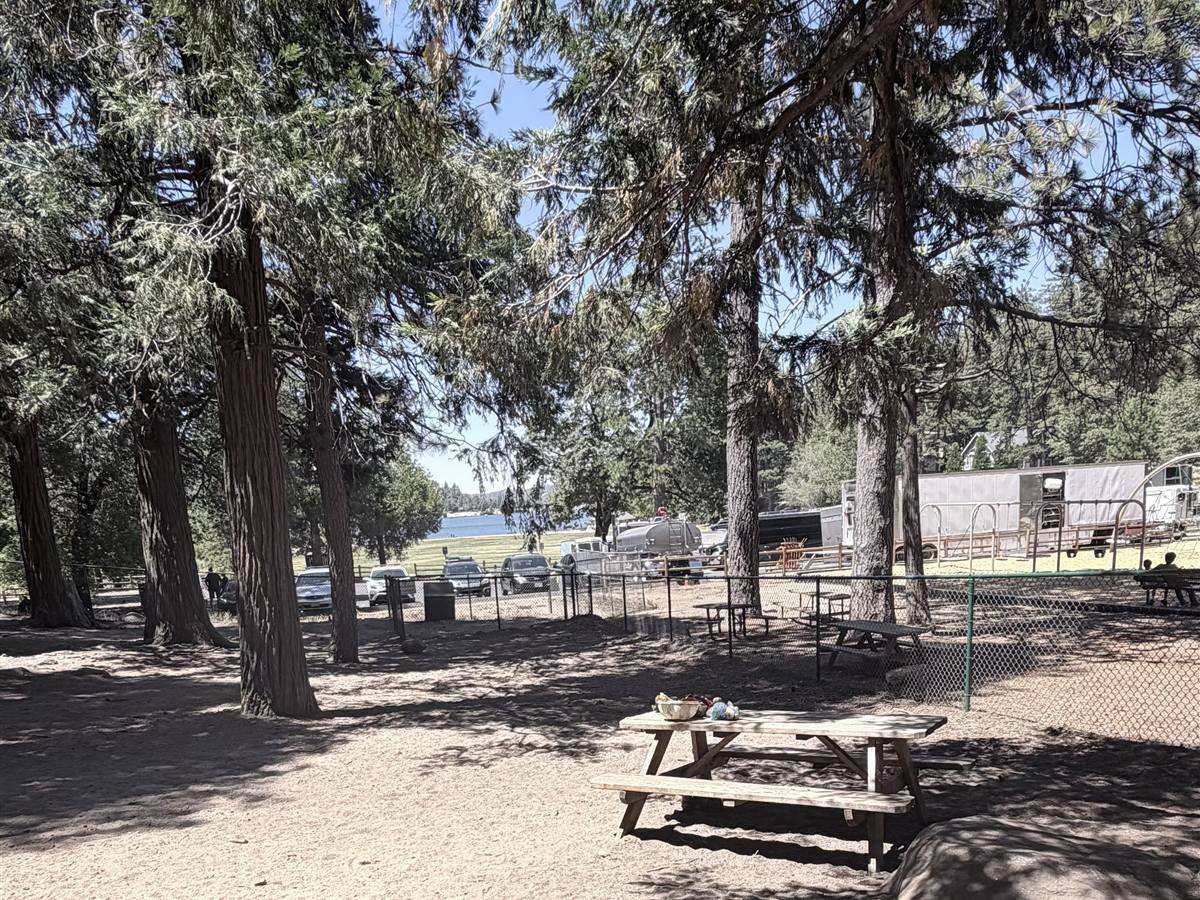
The lot was already three-quarters gone by the time I pulled in. Production trucks lined up in neat rows, drivers sitting behind the wheel, engines idling — ready to move the second someone waved them off. What was left for everyone else was a sliver of space near the entrance, already filling up fast.
I found a spot instead. Not a painted space, not a marked spot — just open ground, wide enough to turn around in, close enough to see my van the whole time I was in the park. The kind of spot locals use without thinking twice.
Five minutes in, a security guard found me.
"You need to move your car to the designated area."
I asked him something simple: if the trucks over there were allowed to park outside their own reserved zone yesterday, why couldn't I park here today? He didn't have an answer for that — just a warning that my car would get towed if I didn't move.
I moved it. Not because I agreed, but because that's not the hill worth planting a flag on. What happened next was.
The turn
A park ranger showed up about five minutes later. By then my van was already sitting in the designated spot, so technically he had nothing to enforce. He talked to me anyway.
I told him what I'd told the guard: most of the lot was reserved for the production, they'd left the public a handful of spots, and yesterday I'd watched their own trucks parked outside that reserved zone — in the same "public" section I'd just been told I couldn't use. If the rule only runs one direction, it isn't really a rule. It's just leverage.
The ranger didn't have an answer either, but he didn't brush me off. He asked if I'd talk to his supervisor — the location coordinator running the production's side of things. I said sure.
That conversation was actually the good one. No uniforms, no towing threats, just two people talking. He explained the reservation ran two-thirds of the lot from 6am to 5pm, and yes, technically the crew wasn't supposed to spill outside that zone either. He didn't defend it. He just hadn't had anyone bring it up to him directly before.
Nothing dramatic happened. No refund, no ticket torn up, no viral confrontation. Just an acknowledgment that the asymmetry was real, from someone who actually had the authority to say so.
The thesis
Here's what I keep coming back to: a uniform creates automatic compliance. That's its whole function — you see the vest, you move your car, nobody has to think too hard. But automatic compliance cuts both ways. It also means nobody ever double-checks whether the enforcement itself is consistent. The guard's job was to enforce the posted rule, full stop — asking him to adjudicate fairness on the spot isn't fair to him either. But the system needs someone to escalate to, and most people never actually use that path. They either grumble and comply, or they argue with the person least equipped to do anything about it.
Two minutes of respectful pushback — while still complying — is usually enough to either get a real answer, or expose that there wasn't one to begin with. I moved my car before the ranger even showed up. The pushback was never a refusal. It was just a question that kept getting asked until it reached someone who could actually answer it.
Regulation reality check
Since I started digging into this beyond just my own parking lot, I've noticed how much van life content treats "the law" as one uniform thing, when it's really a patchwork that changes block by block.
The biggest myth going around is some version of "X states have banned sleeping in your car." In practice, that's rarely how it works. Almost nowhere in the U.S. is there a single blanket state law against sleeping in a legally parked vehicle. What actually restricts you is usually a city or county ordinance — and those vary wildly even within the same state.
Florida gets cited constantly as the strict example, and it's not entirely wrong, but it's more nuanced than "Florida banned it." There's no single statewide law that outlaws sleeping in your car. What Florida does have is a 2024 law (in effect since October 2024) that bars cities and counties from allowing regular camping or sleeping on public property — sidewalks, parks, rights-of-way — plus a dense layer of individual city ordinances that add up to one of the least forgiving states to try it in.
California, where I actually live, isn't much better despite the laid-back reputation. Dozens of cities here have their own restrictions: LA limits living in a vehicle near schools, parks and homes, San Diego has written thousands of tickets under its overnight oversized-vehicle rule, and San Francisco restricts overnight parking for large vehicles on posted streets — usually framed around managing homelessness and long-term street parking rather than targeting travelers specifically, but the ordinance doesn't care about your intent.
The real fallback, if you want genuinely legal free camping, is public land — BLM land specifically. There's a lot of it, and dispersed camping is generally allowed, but it's generally capped at 14 days within any 28-day period, after which you're expected to move on — often 25 miles or more, depending on the field office.
None of this is legal advice — I'm not a lawyer, and ordinances change. But "check the local rule before you park, don't assume the state law is the whole story" would've saved me the conversation with the security guard entirely.
Sources, last checked October 2026: Florida HB 1365 (2024) · BLM: Camping on Public Lands · Times of San Diego on oversized-vehicle citations
How I actually deal with it
Nothing revolutionary here, just what's worked so far:
- Comply first, ask questions second. Moving the car cost me nothing. Understanding why cost five extra minutes and got me a real answer.
- Know the local ordinance before you park somewhere gray, not after someone's already knocking on your window.
- Stay close to the vehicle if you're in a spot that isn't clearly marked — it removes most of the guard's actual argument.
- Talk to the person, not the uniform. The guard, the ranger, and the coordinator were three different conversations with three different amounts of authority to actually change anything. Only one of them could.
Why this matters for what's coming
I haven't even left yet, and this happened in a parking lot ten minutes from home. If van life is anything like people say, this is going to keep happening — different lots, different states, different uniforms. That's fine. It's actually the part I'm least worried about.
If something like this has happened to you — the double standard, the guard with no answer, the five-minutes-later conversation that actually went somewhere — I'd like to hear it. This is going to be a running thing here, not a one-off.
Mahalo for reading.